
Industrial Ultrasonic Homogenizer
AALOK / Viking do Brasil Emulsification, cell disruption and nanoparticle dispersion
Industrial equipment for bioproduct processing by acoustic cavitation, with high efficiency and repeatability. Suitable for pharmaceutical, biotechnology, cosmetics, food and fine chemicals — from lab bench to industrial scale.
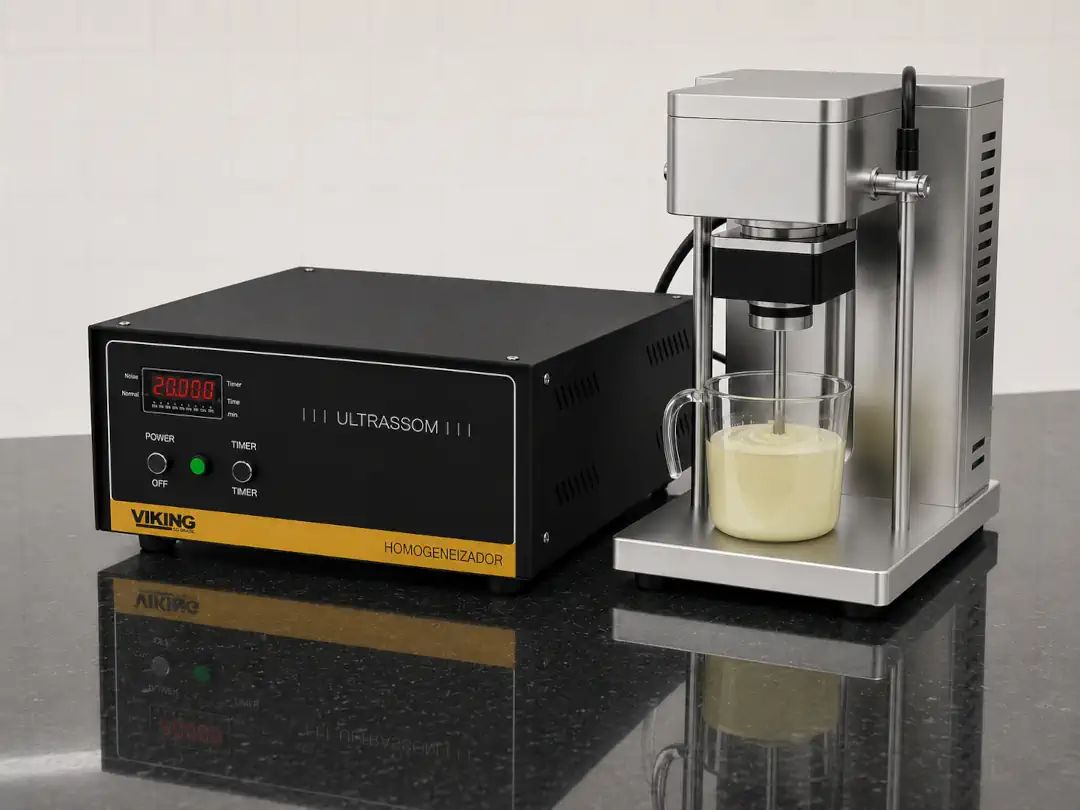
How ultrasonic homogenization works
Acoustic cavitation for emulsions, cell disruption and dispersion
Ultrasonic homogenization is a mechanical process that uses high-power ultrasound waves applied to liquids or suspensions. When ultrasonic energy is transmitted into the liquid medium through a sonotrode, microbubbles form and rapidly grow and collapse — a phenomenon known as acoustic cavitation.
The collapse of these microbubbles generates high shear rates, micro-jets and localized shockwaves, resulting in particle size reduction, intense phase mixing, cell and tissue disruption, and efficient nanoparticle dispersion.
The result is a highly efficient, controllable and repeatable process, applicable both at lab bench scale and industrial scale — with no internal moving parts in direct contact with the product.
What acoustic cavitation produces
- 1
The sonotrode transmits high-power ultrasound waves into the liquid
- 2
Microbubbles form and rapidly grow in the liquid medium
- 3
The microbubbles collapse, generating shear, micro-jets and localized shockwaves
- 4
Particles and droplets are reduced and become more uniform
- 5
Cells rupture, releasing proteins, enzymes and biocompounds of interest
Applications
Main applications of the ultrasonic homogenizer
A versatile tool for different stages of development and manufacturing, in laboratories, R&D centers and production lines.
Emulsification and Dispersion
Stable emulsification of oil/water systems and efficient dispersion of particles and pigments.
- Oil/water emulsions (creams, lotions, food)
- Stable pharmaceutical emulsions
- Nanoparticle and pigment dispersion
- Paints, coatings and advanced formulations
Cell Disruption and Extraction
Cell lysis for extracting high-value biocompounds from biological and plant matrices.
- Protein and enzyme extraction
- DNA/RNA extraction
- Phytotherapeutics and nutraceuticals
- Functional extracts from plant matrices
Preparation and Quality Control
Fast, reproducible preparation of laboratory samples and test formulations.
- Biological and environmental samples
- R&D test formulations
- Suspension deagglomeration
- Degassing of liquid formulations
The ultrasonic homogenizer can also be integrated into inline processes, with dedicated flow cells, reducing handling steps and increasing production consistency.
Who it’s for
Target segments for the ultrasonic homogenizer
Designed for companies and institutions that need to raise the level of control and performance in processing bioproducts and complex formulations.
Pharmaceutical and Biotechnology
Development of vaccines, biopharmaceuticals, advanced therapies and injectable products.
Food and Beverages
Stable emulsions, functional ingredients, beverages with fine, uniform particles.
Cosmetics and Personal Care
Creams, serums, lotions and high-performance products with superior texture and stability.
Fine Chemicals and Specialties
Dispersion of pigments, additives and nanoparticles for high-value-added products.
Universities and R&D Centers
Laboratory testing, formulation studies and process scale-up.
Quality Control Laboratories
Fast, reproducible sample preparation for analysis.
Why choose
Benefits of ultrasonic homogenization
Compared to traditional mechanical and high-pressure homogenizers, the ultrasonic homogenizer offers important advantages for those seeking efficiency, scalability and quality.
Who already benefits
Established technology in labs and industries
Ultrasonic homogenization is already widely used worldwide to improve product performance and process efficiency.
A biopharmaceutical manufacturer adopted ultrasonic homogenization in the cell disruption stage for protein extraction, achieving a significant increase in extraction yield, with better temperature control and less damage to the molecules of interest.
A premium cosmetics company started using ultrasonic homogenization to produce more stable emulsions in creams and serums, with a more pleasant texture, greater stability and a lower rate of production rework.
An advanced materials research lab uses ultrasonic homogenizers to disperse nanoparticles and nanofillers in liquid matrices, achieving more homogeneous dispersions and more consistent experimental results.
See it in action
The Ultrasonic Homogenizer in operation
Coming soon: videos of the equipment in use in practice.
Part of the AALOK Group — over 40 years in industrial ultrasound
The Ultrasonic Homogenizer is developed by AALOK in partnership with Viking do Brasil, combining the robustness of our industrial equipment line with the precision required in biotechnology and laboratory applications.
Request your quote
I’d like to receive
a quote
Talk to our technical team to evaluate whether ultrasonic homogenization is the best solution for your process — from application analysis to recommending the best equipment setup and integration with your line.